Monday, May 20, 2013

Magic Monday, Rune Casting


Reading runes is different from reading tarot cards. Instead of placing them into a spread, you simply choose some from a bag or pouch and cast them (scatter/lightly throw) out on a table or cloth. When consulting the runes, grab however many you need for your reading, hold them in your hand and think of the question you wish to be answered, then scatter them. Take note as to which ones land face up, these relate to the recent situation you are in. Although there is really no perfected way to read runes, generally the ones lying in the center represent what is currently relevant while those lying around the center are less important. Those that fall opposite each other may represent opposing forces.

Once you have interpreted the stones facing up, you may turn over the stones that are lying face down, these represent the future or possible outcome. There are a few different general castings you can do such as the Norns (a three rune casting), Odin's nine rune casting and/or a one rune casting. For a quick daily reading use the one rune casting, a three rune casting for a past, present, future reading and a nine rune casting for a more in depth look at the answer you seek. You can really use any number of runes you like to do a reading, the numbers three and nine were sacred to the Norse people so those are the ones I have shared.  Enjoy divining with the runes!

Saturday, May 18, 2013

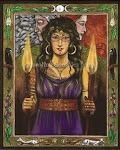
Marie Laveau, Voodoo Queen of New Orleans


Marie Laveau was born a free woman of color on September 10, 1794 in Louisiana. She is known to be the most famous and powerful Voodoo Queen in New Orleans. The story of her life and death have some conflicting information and some aspects of her life are simply not concrete. Her father, Charles Laveau, was a white plantation owner and her mother was said to be his mistress and of mixed races. Marie Laveau married Jacques Paris, also a free man of color, around the age of twenty five. Soon after they were married, Paris is said to have gone missing or perhaps died, the accounts aren't entirely sure. Either way Marie started calling herself the "Widow Paris" as was custom in that time. Within a little while after Paris's death Marie married Christophe de Glapion and together they had anywhere from seven to fifteen children.
 

Her occult practice was a mix of Roman Catholic beliefs, Saints and African spirits. She was renowned for her magical capabilities and is reputed to have had a large multiracial following. At some point she is said to have become a hairdresser and soon became a confidant and magical practitioner for the multiracial women who employed her. Her magical skills were said to be strong in matters of love and money. She was also an accomplished healer, knowledgeable in medicinal herbs and was a nurse during the yellow fever outbreak. Marie is said to have been a spiritual healer and would sit with people who were about to pass over and guide them peacefully to the afterlife. Eventually everyone was coming to Marie Laveau for advice and for magical concerns.
 

One of her daughters, also named Marie Laveau, is said to have followed in her mothers footsteps and together they created and held large ceremonies such as the festivities of St. John's Eve which is celebrated on June 23rd and coincides with the summer solstice. This was a huge gathering with hundreds, and reputedly thousands of spectators at one point, and is a sacred day on the Voodoo calendar. The festival consisted of drumming, dancing, bonfires and offerings to the Voodoo spirits. During this ceremony Marie danced with her snake and sat on her throne presiding over the ceremony.
 

There is much mystery surrounding Marie's life and death. Accounts say that she died in 1881 peacefully in her home. Although some reports claim that she was seen walking the streets on the night of her death and after. Other accounts say that she was seen performing rituals as late as 1890. Her daughter, who is said to have looked like her, took over the spiritual practice and became a Voodoo Queen herself and historical accounts often confuse the two. Marie is buried in St. Louis Cemetery number one in the Glapion family crypt. Each year many people visit her tomb and bring offerings of white rum, candy and money for Marie's blessing. People also draw three X's on her tomb in hopes that she will grant their wish.
 

Some people say that Marie Laveau never died and that her spirit lives on in New Orleans. In Voodoo religion a Queen practitioner who dies is said to advance to the next spiritual realm. Honor this famous Voodooienne on her birthday and on St. John's eve or the summer solstice. 


Photo courtesy of Carolina Gonzalez

Thursday, May 16, 2013

Gyhldeptis, Native American Goddess of the Forests


Gyhldeptis was a Native American Goddess honored by the Haida and Tlingit tribes in Alaska and Canada. She is known as a coastal forest Goddess with long hair whose name means "Lady Hanging Hair" representing the long moss hanging from the cedar trees. She is protector of the forest and its creatures as well as the people who worship her, she is also seen as the spirit of the trees. Gyhldeptis helps us in times of stress and chaos. She assists in calming us and brings us back to our center.

In her myth Gyhldeptis becomes worried by the acts of Kaegyihl Depgeesk, "upside down place", which is a large whirlpool that's very dangerous and destructive to her people. It has already dragged traveling ships down into its depths so Gyhldeptis decides its time to do something about this. She invites the local elemental spirits of wind, fire and ice to her festival house for a great feast. Together they come up with a plan. They reshape the coast turning the destructive whirlpool into a calm flowing river. Now people can sail and fish the water without worry of the terribly chaotic energy from the whirlpool.

Just like the dangerous whirlpool in her myth, life can sometimes feel like a spinning whirlpool of chaotic energy and stress. Gyhldeptis reminds us of the calm flowing river. She teaches us to stay cool and focused, take a step back and re-evaluate your situation. Call on Gyhldeptis when you are feeling overwhelmed and stressed. Associations with this Goddess would be cedarwood, moss, walking in the woods or in nature, and/or reconnecting with nature spirits. I hope you enjoyed learning about this Native American forest Goddess! 


Picture courtesy of Hrana Janto 

Monday, May 13, 2013

Magic Monday New Tarot Spread


I've decided to add a new section to my blog called Magic Monday where I will share different magical workings with you! For today I wanted to share a new tarot spread that I found and love. It's called the whole self spread and it helps with decision making, understanding your inner self and other aspects about your life. Possibly questions about yourself or a part of your life that's unsure? Or helping you to empower your inner self to give you the confidence to move forward or accomplish what you need to do.

For this spread you will only use the aces, kings, queens, pages and knights. Take these cards out of the pile and separate them into five piles of four cards then shuffle each pile. When you are ready, pick your ace card first and lie it face down, repeat this with the rest and follow the picture above. The shape of the spread represents the circle with a dot in the center symbolizing wholeness and the inner self. After you have all your cards laid out face down, you may turn over the center card.

When reading your cards take note if there is a particular suit that is dominant or not in the spread at all. This will help you to get a better understanding on your reading. The following list represents what each cards meaning stands for in the reading:

Ace - Divine forces, energy, virtue, spiritual essence
King - The ego, who you think you are, consciousness
Queen - The subconscious, who you may not know yourself to be
Knight - Initiation, challenge, lesson learned
Page - Action to undertake to create empowerment

I hope you all find this reading helpful with any life decision or getting to know your inner self. This spread came from Best Tarot Practices by Marcia Masino and I highly recommend this book for anyone who wants to learn tarot.  Have a magical Monday!

Sunday, May 5, 2013

Enheduanna, Ancient Priestess of Sumer

Enheduanna was an ancient princess of Sumer, and priestess of the God Nanna, who lived around 2300 B.C.E. She is well known for the hymns she wrote in honor of the Goddess Inanna and for different temple complexes within Mesopotamia. Historical texts say that she was daughter to king Sargon of Akkad and Queen Tashlutum. She is the oldest named writer and poet known thus far in history as well as the first feminine name recorded in history. She was appointed the role of high priestess for the God Nanna in the Sumerian city of Ur by her father. This was said to be a political move by the king, her father, in order to gain power in Southern Mesopotamia. Her title was En Priestess, En meaning "High Priest or Priestess". This was a common role held by daughters of royalty.

Although she was a high priestess of the God Nanna, she was extremely devoted to the Goddess Inanna as is seen in her literary works. She is said to have written about 50 hymns in her day and these were used during ritual and ceremony for 500 years after her death. During the reign of her brother Rimush, she is said to have had trouble with a man named Lugalanne who was intending to take over rule. She was then banished from her role as priestess and from the temple. She mourned this loss deeply as can be seen in her most famous poem "The Exaltation of Inanna". After this powerful poem was written her position in the temple was reinstated and Enheduanna is happy once more.

Below is The Exhaltation of Inanna translated by Dr. Annette Zgoll.:

Queen of all the me, too numerous to count, rising forth as resplendent light
Woman, most driven, clothed in frightening radiance, loved by An and Uras, 
An's nugig, you are above all the great SUHkese-breastplates, 
You, who love the right aga-crown, who is suited for the en-priest-hood,
Empowered with all of its all seven me.

My queen! You are the guardian of the great me!

You have uplifted the me,  
You have held the me in your hand.
You have gathered the me,  
You have clasped the me to your chest.

Like a dragon you cast venom upon the enemy land.

In the regions where you thundered like Iskur,
Asnan no longer exists because of you 
Flooding waters surge down on such an enemy land 
You are the supreme one in Heaven and Earth, 
You are their Inanna! 

For more on this ancient priestess check out : Enheduanna

Friday, March 8, 2013

Crafts for the Spring Equinox!


It's almost time for the Spring Equinox, when we honor the coming of Spring, life and rebirth. New sprouts of green shoot up from the now again fertile earth, animals come out from winter hibernation, and new life is born. The typical symbols for the Spring Equinox, or Ostara, are eggs, rabbits, birds, flowers, butterflies and other greenery. There are some wonderful crafts and food to make at this time of year, I will share some of my favorite.

An Ostara tree is fun and easy to make, and also great for kids. It's a great way to bring a little nature inside to celebrate the new life of the season. This picture is of my Ostara tree. I used branches that had fallen from trees, and also some flora from the crafts store. These are instructions that I found on About.com, but please feel free to get creative with your tree.

Ostara Tree Supplies:

Several lightweight branches
Some florist's foam
A flowerpot
Acrylic paints
Spanish moss
Small spring decorations

First, paint the pot with spring designs -- flowers, butterflies, ladybugs, eggs, etc. If you have kids, this is a lot of fun. If you don't mind them getting a bit messy, let them use thumbprints to make designs. Allow the paint to dry.

Cut a chunk of florist's foam to fit into the pot and then insert the branches into the foam so that it forms a tree shape. Hang the decorations -- eggs, ribbons, flowers, etc. -- on branches. Use the Spanish moss to cover the florist's foam in the top of the pot.

You can personalize your tree anyway you like. Make your own ornaments from polymer clay or buy some already made. For my tree I decided not to paint the flower pot to leave it more natural looking.


Other things that I love making for seasonal celebrations are wine and food. I found a great recipe for Raspberry wine and chocolate eggs that are divine!


Raspberry Wine

2 1/2-pint baskets fresh raspberries
2 tbsp sugar
1/2 cup plus 2 tbsp raspberry liqueur
1/4 cup cognac or other brandy
1 750-ml bottle white wine

Combine 2 baskets raspberries and 2 tbsp sugar in medium bowl. Mash berries lightly with fork. Let stand 15 minutes. Mix in liqueur and brandy. Pour into jar. Cover and let stand in dark cupboard 3 days. Strain raspberry mixture, pressing on solids with spoon to extract as much liquid as possible. (Can be made 1 month ahead. Cover; chill.)


Chocolate Ostara Eggs

In both ends of 8 eggs, poke pinholes. Blow in one end until egg is emptied out. Tape one hole shut and open the other to the size of a nickel. Wash the eggshell, rinse, and place back in egg carton.

Melt milk chocolate over low heat(I use chocolate chips). Pour chocolate into egg shells. Refrigerate until chocolate hardens. To eat, peel off outside shell. You could also get creative and add toffee pieces or caramel.


I found these original recipes on Mistresskalpanasrealm, but I tweaked the ingredients a little to my own preference. Be sure to check out this website, there are many great Ostara recipes!

Have fun making your Ostara tree and treats. Wishing everyone a delightful season of life and rebirth!


Monday, February 11, 2013

Jezebel, Princess of Phoenicia, Queen of Israel


Jezebel was a Phoenician princess around 900 BCE. Daughter to Ethbaal, king of Tyre in Phoenicia, and wife to Ahab, king of northern Israel. It is said by many archaeologists and scholars that Jezebel was really the one in charge, not her husband and king. She still honored her ancient religion and did not covert to Judaism. She convinced her husband to worship her Phoenician God Baal, who was seen as a God of fertility, rain and the seasons. They had temples erected in his honor which was seen as sinful by the other Israelite's. They viewed Ahab not only sinning against his own God, but also against his people. First by marrying a Phoenician princess who was viewed as a Pagan, then by worshiping the Phoenician God.

Although it didn't end there. Jezebel did not want to loose her cultural identity and her Gods and Goddesses from her home. She was a bold and fierce woman and some will say that her actions were brutal, but in that time, Pagans had been dealing with the constant threat of Judaism and Christianity, for some thousand years or so at that point. Some followers of ancient religions were not as eager or willing to give that up so easily, like Jezebel. She started having prophets of the Israeli God killed off.  Although it is said many died, many also survived. Jezebel would stop at nothing to see this new religion gone. She was spoken badly about  by worshipers of God and in biblical texts she is described as a wicked woman who dressed herself in makeup and sinful clothing, she was even portrayed as a prostitute, a harlot.

Women were viewed much differently in this new religion and the men did not take to the old ways of women making themselves attractive or holding any power. Any woman who held power was seen as evil and ungodly. Jezebel was viewed as such. It is said that Elijah, a prophet of God proposed a contest with the worshipers of Baal, and the prophets of God at Mt. Carmel to see which deity was the true God. Some four hundred and fifty followers of Baal and four hundred prophets of God gathered at Mt. Carmel. The contest was to attempt to set a sacrificial bull on fire by the power of their God. The prophets of Baal are said to have prayed and danced to their ancient God all night, though we're not successful. Elijah's prayers were answered with one plea to his God and the bull was set aflame. Though this is what reads in the Biblical texts, we well never really know the truth behind this story as to how the Israelite's won this contest. After winning, Elijah declared their God the one and only true God.

After this Elijah orders all four hundred fifty prophets of Baal to be captured and then had them all slaughtered. When news of this reaches Jezebel by her husband Ahab, she sends a warning message to Elijah that he shall be killed just as he slaughtered hundreds of her people. She is a strong woman, willing to stand up for and fight for her beliefs until the end.

After this Jezebel sends her husband to a man named Naboth, an Israelite, who owned a vineyard next to the palace of Jezebel and Ahab. The king goes to Naboth and asks him for his land so he may use it for vegetables. Naboth refuses invoking the power of God. Ahab returns to Jezebel to inform her. Being that in her homeland, a powerful woman had much sway, she decided to take this into her own hands. She sends out letters to the townspeople falsely accusing Naboth of blasphemy against the Israeli God, and stamps them with her husbands seal. They take Naboth out and stone him to death. It is at this point that Elijah returns and talks to Ahab about how he will kill Jezebel.

It is after a while when Jezebels son, Joram, assumes the throne after Ahab dies. Although Elijah decided to crown Jehu, Jorams military commander. Jehu commands Joram out one day to the battlefield, and kills him. After this he races his chariot to kill Jezebel. Knowing he is coming for her, she does not flee, she stays and puts kohl around her eyes, brushes her hair, and dresses in her finest. To her this is her finest hour, she is willing to die for her cause. She stands on her balcony waiting for Jehu to arrive. When he gets there and sees her he orders his people to throw her out of the window. She lands on the ground and then Jehu declares that her body will be eaten by dogs. She dies in a horrific way and Jehu leaves her body on the street while he and his men celebrate.

Jezebel was a powerful Queen of Israel, even though she was a woman in this new land where women held no power, she was not willing to let go of her Phoenician roots and religion. She would not under any circumstance allow this new religion and its people to tear her away from herself. She would rather die then live in a world that she did not believe in.

I hope you enjoyed learning about Jezebel, Phoenician Queen of Israel!


Photo courtesy of Villains
Message Non-Alert Script:
Related Posts Plugin for WordPress, Blogger...